
Before we dive into what you can do with a 1031 exchange today, we need a little history.
1031 exchanges have traditionally been called like-kind exchanges. And, as I tell my students, whenever there’s a law, there are also going to be rules. Section 1031 itself isn’t terribly long. The regulations, IRS guidance and court decisions that have grown up around it are another matter entirely.
Some of those rules exist because somebody was willing to fight with the IRS.
Along Came Mr. Starker

One of the most important people in the history of the 1031 exchange was a gentleman named T.J. Starker.
At one time, exchanges were generally thought of as just that—exchanges. I give you my property and you give me yours.
Starker didn’t do that.
His transaction stretched out over a period of years.
The IRS essentially said, “You can’t do that.”
Starker said, in effect, “Yes, I can.”
And he won.
The 1979 Starker decision established that an exchange did not necessarily have to happen simultaneously. As you might imagine, the government wasn’t terribly excited about the prospect of exchanges remaining open indefinitely.
Eventually Congress stepped in. In 1984, Congress amended Section 1031 and put the deadlines we know today directly into the law. Treasury regulations and IRS guidance provide much of the detailed machinery for making those exchanges work.
And those deadlines are important.
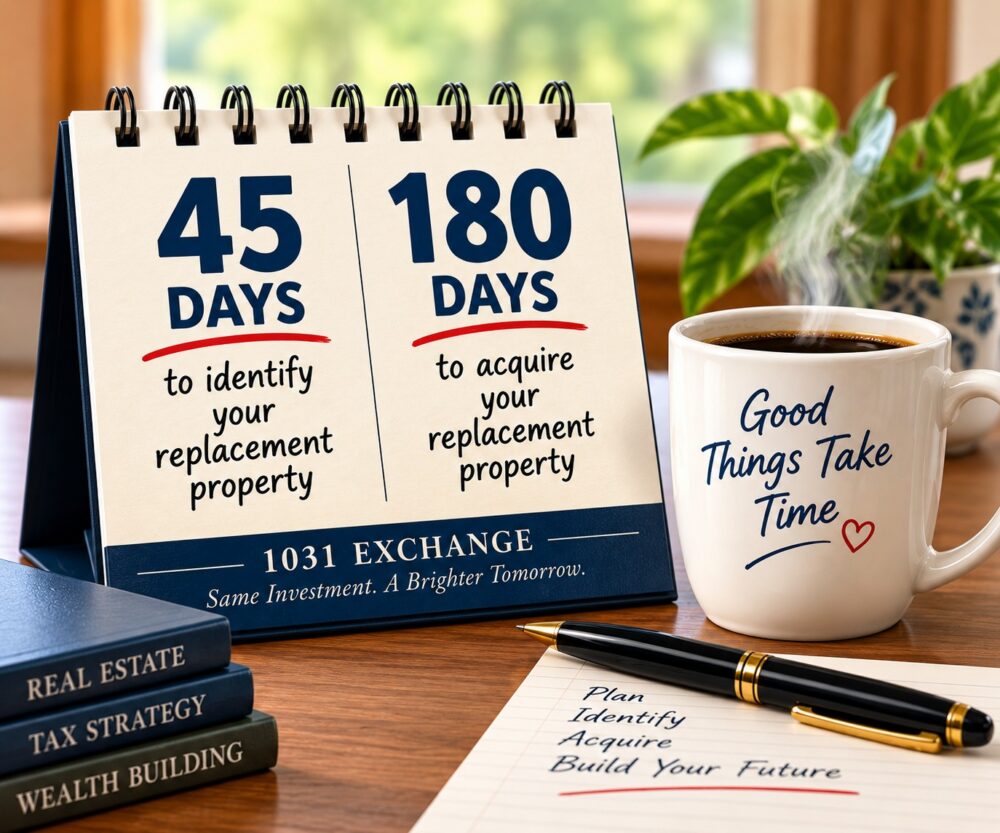
45 Days and 180 Days
Once you transfer—or relinquish, in 1031 language—your old property, the clock starts ticking.
You generally have 45 days to identify your replacement property.
The simplest rule allows you to identify up to three possible replacement properties regardless of their value. There are additional rules that may permit you to identify more than three, but that’s where we’re already getting beyond what I want to accomplish here.
You then have to acquire your replacement property by the earlier of:
180 days after transferring the relinquished property, OR the due date of your federal income-tax return for that year, including extensions.
That last part catches people.
Suppose you sell an investment property in November. You don’t automatically have until the following May to finish your exchange. Your income-tax return may be due first. Filing an extension can therefore become very important.
Which brings me to something I cannot emphasize enough:
THIS IS NOT A DO-IT-YOURSELF PROJECT.
Use a qualified intermediary—what we have commonly called an accommodator—and have that person involved before you close the sale of the relinquished property.
I’ve had some amazing questions come up in class over the years.
One of my favorites goes something like this:
“I just sold my property. This 1031 thing sounds like a pretty good deal. What do I do now?”
My response is to hand them a box of tissues.
Why?
Because it is vitally important that the person selling the relinquished property not receive or control the money. In a deferred exchange, the qualified intermediary needs to be properly involved in handling the transaction.
The time to plan your 1031 exchange is before you sell the property—not after the check is in your hand.
What Does “Like Kind” Mean Today?
The words like kind confuse people.
You might reasonably think they mean that you have to exchange a house for another house, land for land, or a commercial building for another commercial building.
That’s not how today’s rules generally work.
Qualifying real property held for business or investment can generally be exchanged for other qualifying real property that will also be held for business or investment.
And don’t let the word “investment” fool you into thinking the property can’t be residential.
It certainly can.
A house, condominium or vacation property may qualify when it is genuinely being held for investment rather than primarily for personal use.
I sometimes explain the personal-use rule to students as:
“Don’t lay your head on the pillow for more than 14 days.”
That’s a useful way to remember it, although—as usual with tax law—the actual safe-harbor rule has more words in it.
For a dwelling unit, the IRS safe harbor includes requirements concerning how long you own it, how many days it is rented at a fair rental, and how many days you personally use it. Generally, personal use cannot exceed the greater of 14 days or 10% of the days it is rented at a fair rental during each applicable 12-month period.
And there’s an important distinction.

If you’re at the property substantially full-time doing repairs or maintenance, those days aren’t necessarily personal-use days.
So spending a week at your rental cottage replacing the deck is quite different from spending a week sitting on the deck with a margarita.
How Many Times Can You Do This?
Another question that comes up is whether there is a limit on how many times you can use Section 1031.
Generally, there isn’t.
If you continue to own qualifying investment or business real estate and continue to meet the requirements, you may be able to exchange again and again.
There’s even a phrase people sometimes use for this strategy:
“Swap ’til you drop.”
It’s not particularly elegant, but it is memorable.
The idea is that an investor may continue exchanging properties over the years, deferring recognition of gain each time rather than selling and cashing out.
Then, when the owner dies, inherited property generally receives a basis determined by its fair market value at the date of death, subject, of course, to the applicable tax rules and exceptions.
That can make successive exchanges an extraordinarily useful estate-planning tool.
Now Let’s Add Another Tool
So far, we’ve been talking about using Section 1031 to defer gain.
But that’s only one side of the transaction.
What happens after you’ve acquired the replacement property?
That’s where another tax-planning tool can become very interesting: cost segregation.
Under current federal law, certain qualifying property acquired after January 19, 2025, may qualify for 100% bonus depreciation.
Real estate itself generally depreciates over a much longer period. But a cost-segregation study can identify portions of the property that qualify for shorter depreciation periods—and some of those components may qualify for bonus depreciation.
Here’s the easiest way I know to keep the two concepts straight:
The 1031 exchange deals primarily with the property you SOLD.
Cost segregation and bonus depreciation deal primarily with the property you BOUGHT.
Let’s Put Some Numbers to It
Suppose you sell an investment property and complete a properly structured 1031 exchange into a replacement property.
After applying the exchange and basis rules, your tax adviser and cost-segregation specialist determine that $150,000 of the basis in the replacement property is attributable to components that qualify for 100% bonus depreciation.
That could potentially produce a $150,000 first-year depreciation deduction.
If, purely for illustration, you were in a 35% federal tax bracket, a fully usable $150,000 deduction could represent roughly $52,500 in federal tax effect.
Now, before anybody starts spending that $52,500—
There are plenty of qualifications.
Your actual result depends on basis, property classification, when the property was placed in service, passive-activity rules, at-risk rules, your particular tax situation, and state tax treatment.
And that leads to an important point:
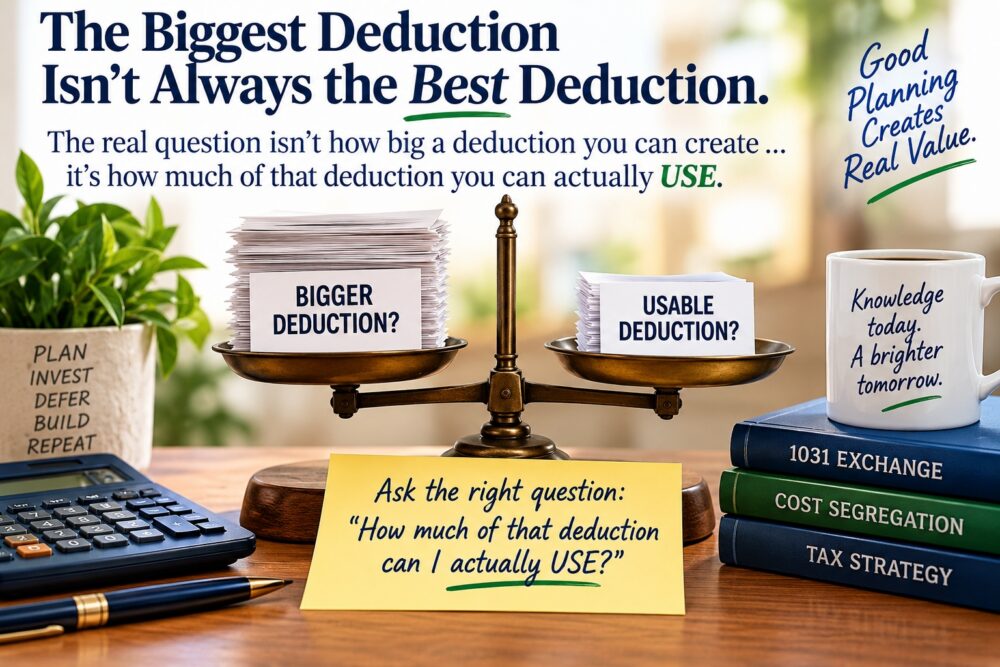
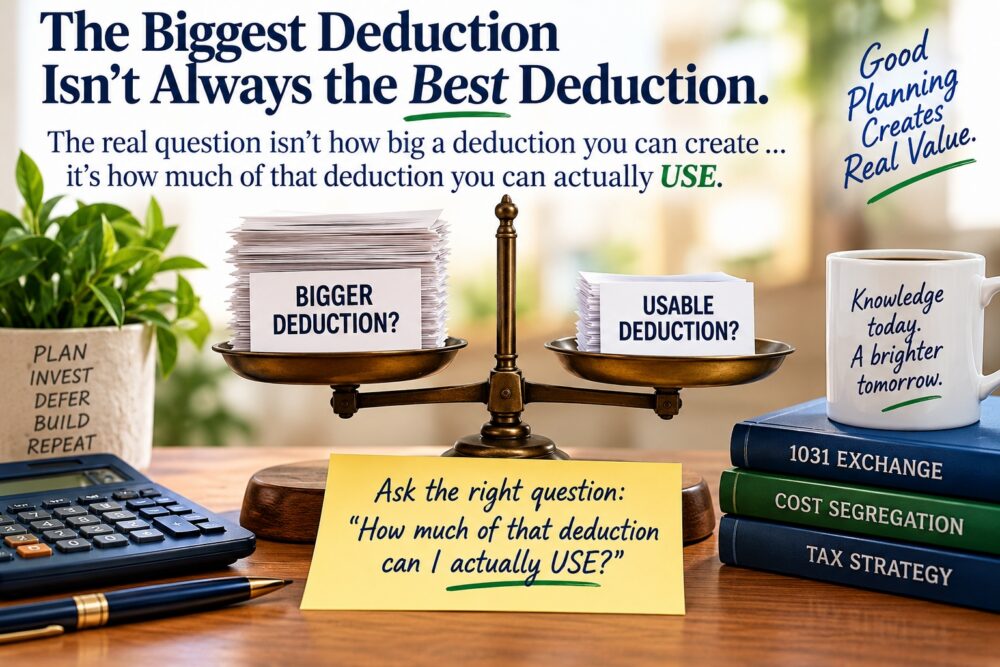
The biggest deduction isn’t necessarily the best deduction.
The question isn’t simply:
“How big a deduction can I create?”
The better question is:
“How much of that deduction can I actually USE?”
What About a Delaware Statutory Trust?
Not everybody wants to exchange into another property that they have to manage themselves.
That’s where a **Delaware Statutory Trust—or DST—**can become interesting.
A properly structured DST may qualify as replacement property in a 1031 exchange. Instead of buying an entire property yourself, you acquire an interest in a trust that owns real estate.
The real estate is generally professionally managed.
Which means:
Somebody else gets the call about the toilet.
For an investor who wants real-estate exposure without tenants, repairs and day-to-day management, that can be pretty attractive.
But don’t confuse a DST with a tenancy-in-common, or TIC. Both can provide fractional interests in real estate for 1031 purposes, but they are different legal structures with different rules and characteristics.
And, as with every investment, there are trade-offs. You need to look at the property itself, the sponsor, fees, financing, liquidity, projected income and your own investment objectives.
Taxes are part of the investment decision. They aren’t the entire investment decision.
Don’t Forget About Basis
Here’s another place where people can get themselves into trouble.
When you complete a 1031 exchange, the replacement property does not simply start over with a brand-new tax basis equal to what you paid for it.
Generally, the basis from the relinquished property carries into the replacement property, with adjustments for things such as additional money invested, debt, gain recognized and other items.
That becomes particularly important when you’re thinking about cost segregation and bonus depreciation.
Suppose you acquire a $1 million replacement property.
You cannot simply say:
“I bought a $1 million building, and my cost-segregation study says 30% qualifies for bonus depreciation, so I get a $300,000 deduction.”
Maybe you do.
Maybe you don’t.
First you have to determine the actual tax basis available in the replacement property. Then you determine how that basis is allocated among land, the building and the various components identified by the cost-segregation study.
In other words:
Don’t confuse PURCHASE PRICE with DEPRECIABLE BASIS.
They are not necessarily the same number.
Do Your Homework Before You Exchange
Before you sell the relinquished property, sit down with the people who understand both the exchange and the tax consequences of what you’re buying.
Ask questions such as:
What will my basis be in the replacement property?
How much of that basis may be depreciable?
Would a cost-segregation study make sense?
Can I actually use the deductions it might create?
Would direct ownership or something such as a DST better fit my investment goals?
What happens when I eventually sell—or exchange—the replacement property?
Those questions need to be asked before the transaction is put together, not after.
And remember:
A tax benefit can make a good investment better. It doesn’t necessarily make a bad investment good.
The Bottom Line
A 1031 exchange can be much more than a way to postpone a tax bill.
Used properly, it can help an investor move from one property to another, reposition a portfolio, move into professionally managed real estate, and potentially combine tax deferral with other strategies such as cost segregation and bonus depreciation.

But—and this is a very important but—a 1031 exchange is not a do-it-yourself project.
The rules are detailed. The deadlines are unforgiving. And once you’ve received the proceeds from the sale, it may already be too late to fix the problem.
Get your qualified intermediary, tax adviser and other professionals involved before you close.
And remember:
The object is to make a good real estate investment and then structure the tax side of it intelligently.
After all, spending a week replacing the deck is quite different from spending a week sitting on the deck with a margarita.
And that’s one tax rule I suspect my students will remember. 🍹